
What independent studies found, who gets flagged unfairly, and how much weight a score deserves.
The short answer: accurate enough to be useful, not accurate enough to be proof. AI detectors catch a lot of unedited AI text. They also flag human writing, miss edited AI writing, and disagree with each other.
In 2023 a group of academic integrity researchers tested 14 detection tools on human-written, AI-written and edited text. Their conclusion was that the tools were neither accurate nor reliable. Every tool scored below 80% accuracy and only five scored above 70%.
Two patterns stood out. The tools leaned toward calling a text human, so a good share of AI text went through unflagged. And once AI text had been paraphrased or edited, performance dropped sharply.
Detectors have improved since then. So have the models they are trying to catch.
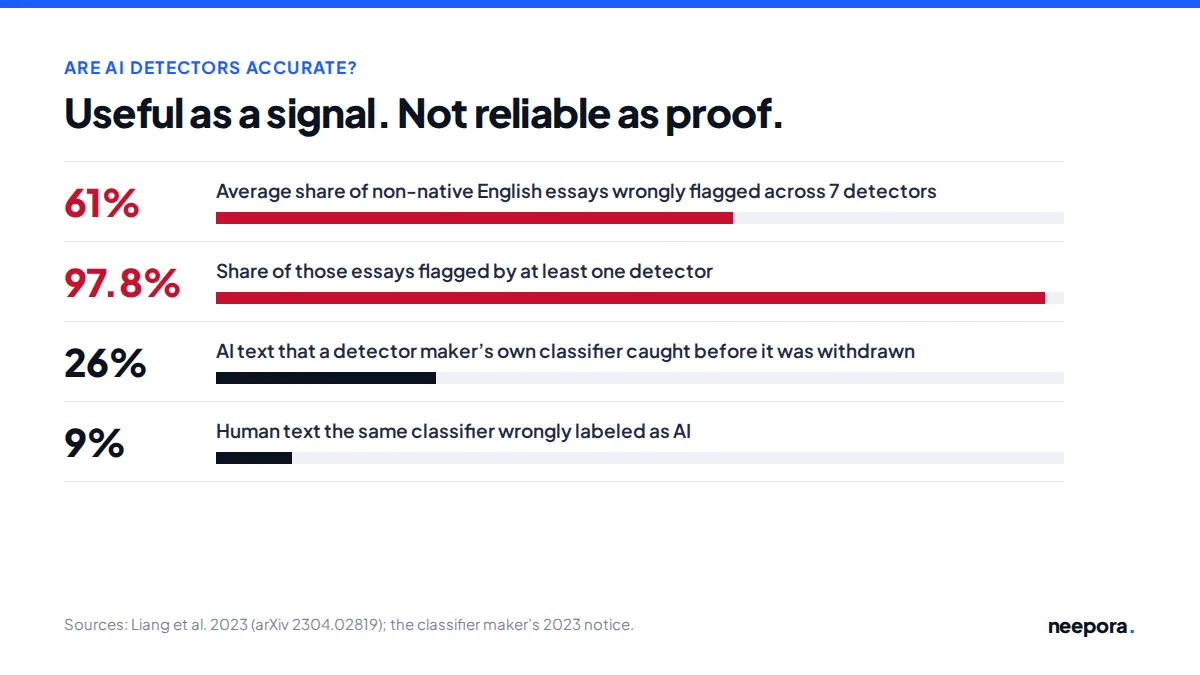
The costlier mistake runs the other way. A 2023 study from Stanford ran 91 essays written by non-native English students through seven detectors. On average the detectors flagged about 61% of them as AI. Nearly all of the essays, 97.8%, were flagged by at least one detector. Essays by American eighth-graders were almost never flagged.
The reason is uncomfortable. People writing in a second language tend to use a smaller vocabulary and simpler sentence structures. To a detector, simpler and more predictable looks like a machine.
In January 2023 a leading AI lab released its own detector. By its own figures, it correctly identified 26% of AI-written text and wrongly labeled 9% of human writing as AI. The lab withdrew the tool that July, citing its low rate of accuracy.
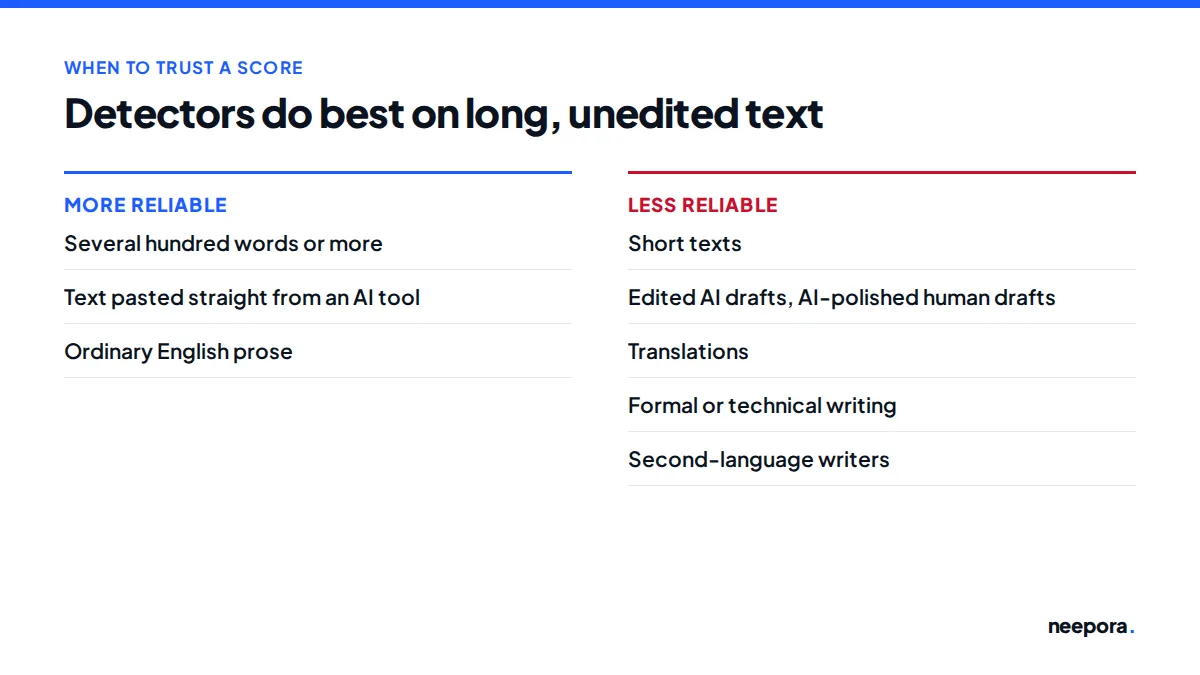
Treat it as evidence, not as a verdict. Look at which sentences were flagged and whether they have anything in common. If the stakes are high, run the text through more than one detector and ask for what a detector cannot see: drafts, notes, version history, a conversation about the work.
No decision about a person should rest on one number from one tool.
Weber-Wulff et al., Testing of Detection Tools for AI-Generated Text (2023).
Liang et al., on detector bias against non-native English writers (Patterns, 2023).
Announcement and withdrawal notice for an AI text classifier (2023).
Why is my writing flagged as AI?
Falsely accused of using AI? What to do
Check a text with the AI detector
Updated October 7, 2026