
The nine most common reasons a detector mistakes human writing for AI, how to spot each one in your own text, and what to do if it already happened.
AI detectors do not know who wrote a text. They measure how predictable it is. Writing that uses safe, common word choices, sentences of similar length and stock phrases looks statistically like AI output, so careful, formal or second-language writing is often flagged even when a person wrote every word.
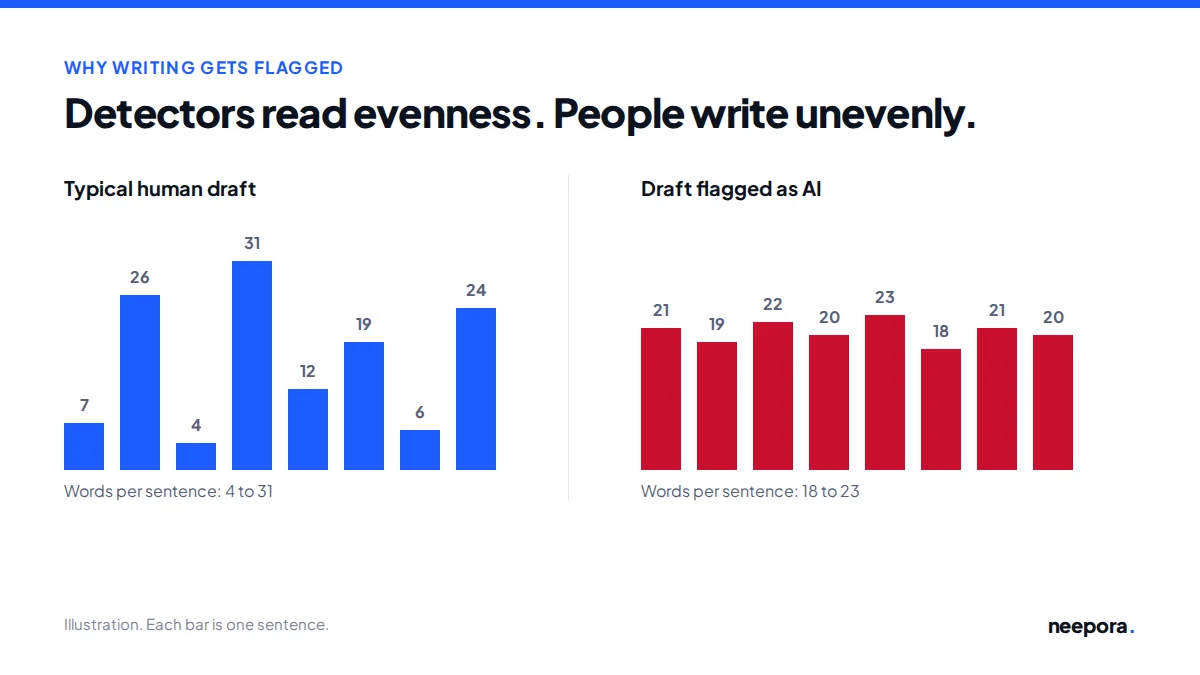
Most detectors score a text on two things: how surprising each word is given the words before it, and how much that surprise varies from sentence to sentence. Low surprise and little variation read as machine-written. Every reason below comes back to one of those two measurements.
Read a flagged paragraph against this table. Most flagged passages show two or three of these at once.
| Pattern | What it looks like | What to change |
|---|---|---|
| Even rhythm | Every sentence 15 to 25 words, same structure | Break one long sentence in two; join two short ones; start one with the verb |
| Stock transitions | Moreover, Furthermore, Additionally, In conclusion | Delete them, or say how the ideas connect in plain words |
| Safe vocabulary | significant, various, crucial, enhance, utilize | Use the word you would say out loud |
| Generic claims | "This has many benefits for society" | Name one benefit, one person or one number |
| Lists of three | "clear, concise, and engaging" in every paragraph | Keep the one item that matters most |
| Hedged conclusions | "Overall, it is clear that..." | End on your strongest specific point instead |
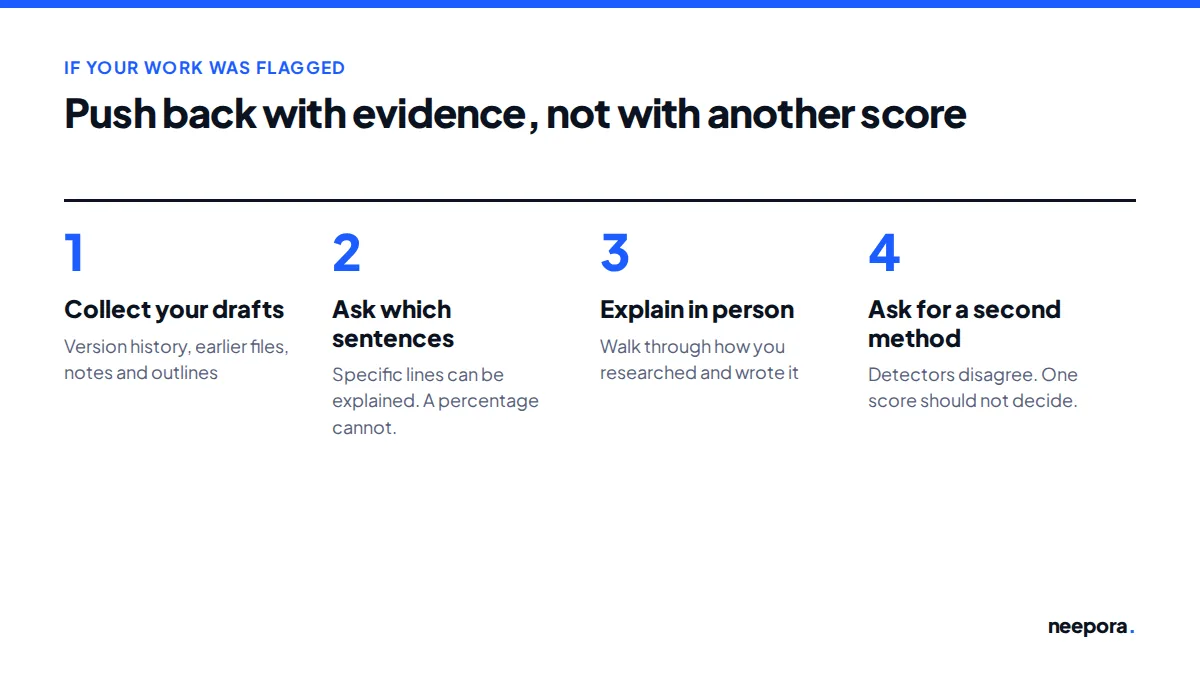
A detector score is a probability, not proof. Independent testing found that no widely used tool was reliably accurate, and that results got worse on edited text. You are allowed to push back, and the strongest way to do it is with evidence of how you wrote.
For more on how far a score can be trusted, see are AI detectors accurate?.
You do not need tricks. Edit the way a good editor would: read the flagged sentences aloud, change the rhythm, cut the filler, and add a detail only you would know. Then check the paragraph again with an AI detector that shows sentence-level results so you can see which lines still read as predictable.
Before and after, as an example of the kind of change that helps:
| Sentence | |
|---|---|
| Before | Furthermore, social media plays a crucial role in shaping the opinions of young people in various ways. |
| After | My younger brother changed his mind about a city council vote after one video. That is how fast it happens. |
No. A detector estimates how likely a text is to be machine-written based on statistical patterns. It cannot see how the text was produced, and every detector makes mistakes on human writing.
Usually because it is very even: similar sentence lengths, common word choices, stock transitions and general statements. Those are the same patterns language models produce by default.
They can. Tools that rewrite or rephrase sentences for you remove irregularities that make writing look human. Simple spelling and punctuation fixes have much less effect than full-sentence rewrites.
Some readers treat heavy use of em dashes as a sign of AI writing, but detectors score the whole pattern of word choices, not a single punctuation mark. Using them now and then is not a reason a text gets flagged.
Yes. A 2023 study found that detectors flagged about 61% of essays by non-native English writers as AI on average, while essays by native speakers were rarely flagged.
Longer is more reliable. A few sentences give a detector too little to measure; several hundred words give it much more, though no length makes a score certain.
Weber-Wulff et al., Testing of Detection Tools for AI-Generated Text (2023).
Liang et al., GPT detectors are biased against non-native English writers (Patterns, 2023).
Falsely accused of using AI? What to do
Updated October 10, 2026