
A calm, practical plan for students and writers whose own work was flagged as AI: the evidence that helps, a message you can adapt, and the mistakes to avoid.
If you are falsely accused of using AI, do not delete anything or admit to something you did not do. Ask exactly what the accusation is based on, gather evidence of how you wrote the work (version history, drafts, notes, sources), offer to explain your work in person, and point out that AI detectors have documented error rates. If the outcome is still unfair, use the formal appeal process.
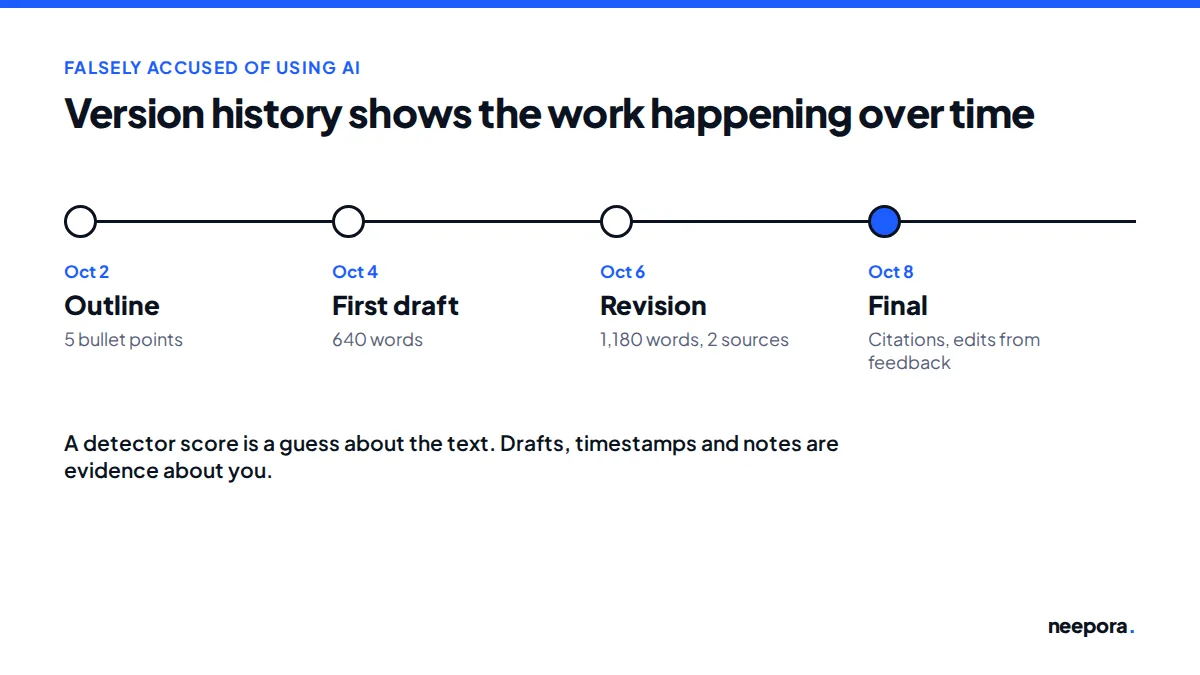
No single item settles it. Several pieces that show the work growing over time are far more convincing than any detector score.
| Evidence | Where to find it | What it shows |
|---|---|---|
| Version history | Google Docs: File, then Version history. Word: Version History for files saved to OneDrive or SharePoint | The text being written and revised over hours or days |
| Earlier drafts | Old file copies, email attachments, cloud storage, USB backups | How the argument changed between versions |
| Notes and outlines | Notebooks, note apps, photos of handwritten notes | Planning that came before the final text |
| Research trail | Browser history, saved PDFs, library records, citation manager | Sources you read and when you read them |
| File metadata | File properties: created and modified dates, editing time | When and for how long the file was worked on |
| Your earlier work | Previous essays or reports in the same course or job | That the style matches how you normally write |
Keep it short, factual and polite. Adapt this to your situation:
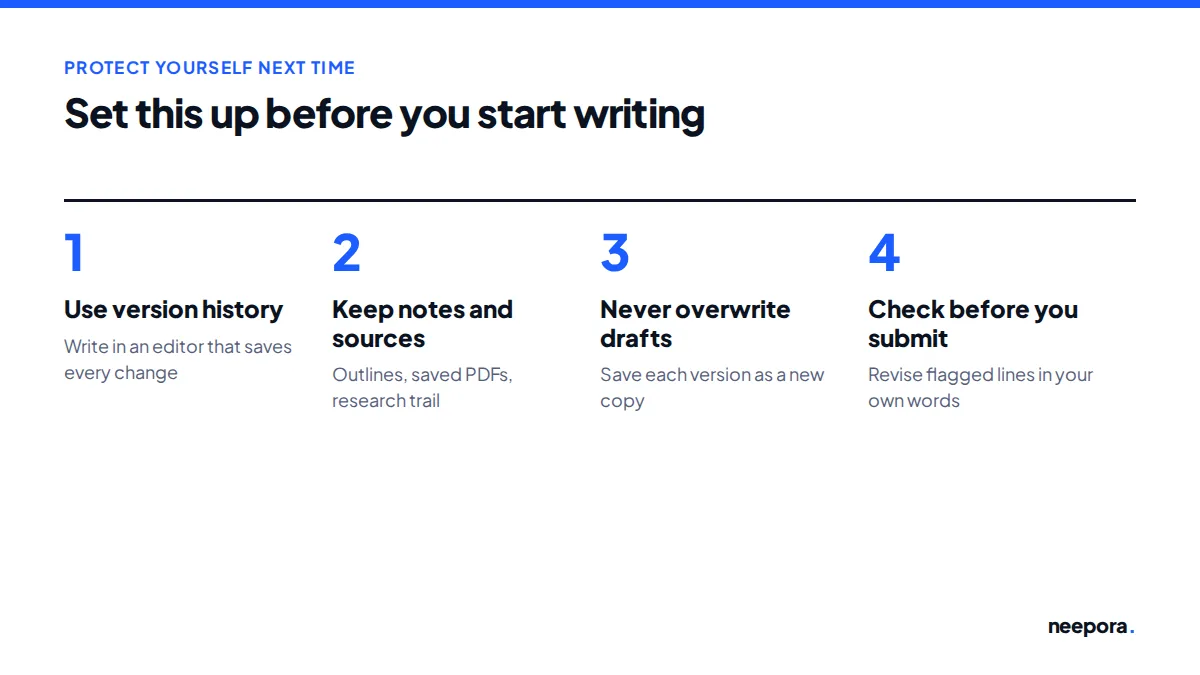
Write in an editor that keeps version history, save your notes and sources, and keep earlier drafts instead of overwriting them. If you want to know in advance how your writing reads to a detector, check it with an AI detector that highlights sentences and revise the flagged parts in your own words. Our guide on why writing gets flagged as AI explains which patterns cause it.
It depends on the institution's policy. Detection tools generally describe their scores as indicators rather than proof, and a fair process should look at other evidence, such as drafts and a conversation about the work.
Show your writing process: version history, earlier drafts, notes, outlines and your research trail, and be ready to explain your work in detail. Several pieces of evidence together are much stronger than any one.
Say so openly. Spelling and punctuation fixes are usually allowed, but tools that rewrite whole sentences can change how a detector scores your text. Check what your policy says about them.
Results from other detectors can show that tools disagree, but they are not proof either. Evidence of how you wrote the work matters more.
Yes. A 2023 study found that detectors flagged about 61% of essays by non-native English writers as AI on average, while essays by native speakers were rarely flagged.
Many schools have a student advocate, ombudsperson or student union adviser who can explain the process and attend meetings with you. At work, HR or a union representative can play the same role.
Weber-Wulff et al., Testing of Detection Tools for AI-Generated Text (2023).
Liang et al., GPT detectors are biased against non-native English writers (Patterns, 2023).
Why is my writing flagged as AI?
How to avoid AI detection in your writing
Updated October 10, 2026