
What a detector measures, what it cannot see, and why it gives you a probability instead of an answer.
An AI detector reads a piece of text and estimates how likely it is that a language model wrote it. It does not know who wrote the text. It has no log of what any chatbot has produced. All it has is the writing in front of it.
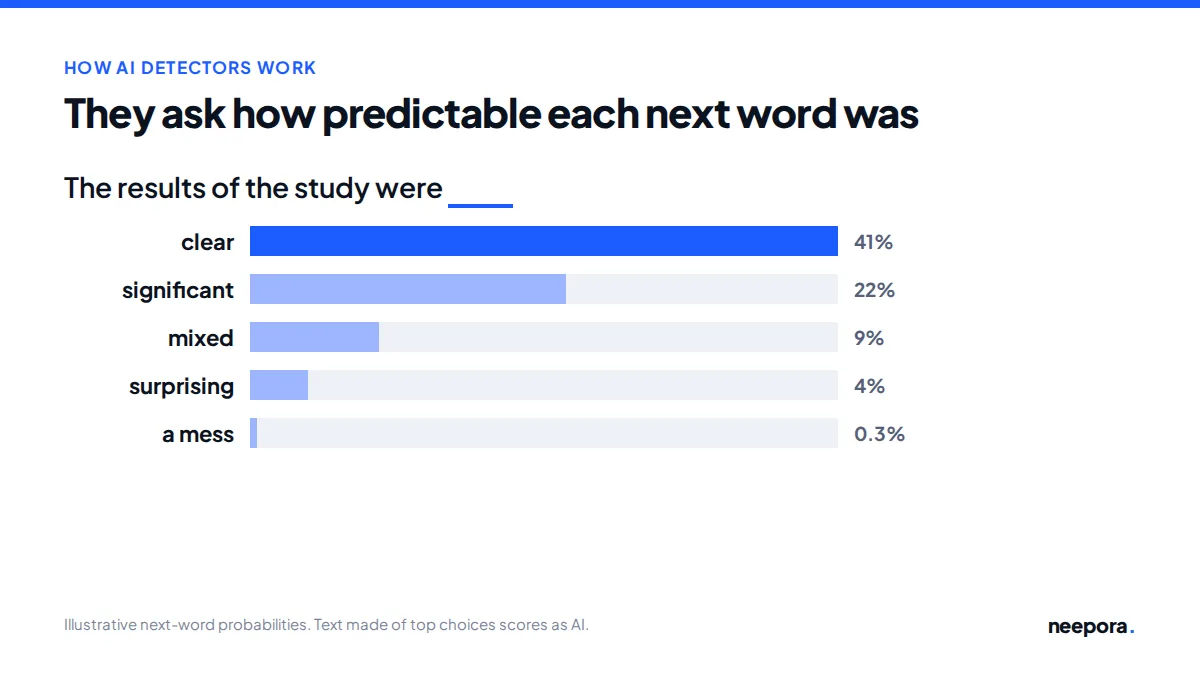
A language model writes by choosing a likely next word, over and over. The result is fluent and rarely surprising. Detectors turn that around. They read a text and ask how predictable each word was, given the words before it.
The technical name for this is perplexity. Low perplexity means the text is close to what a model would have written itself. Human writing tends to score higher, because people reach for the less expected word more often than a model does.
People write unevenly. A short sentence. Then a long one that wanders through two or three ideas before it lands. Then a fragment. A model stays inside a narrower band, so its sentences come out at similar lengths with similar structures.
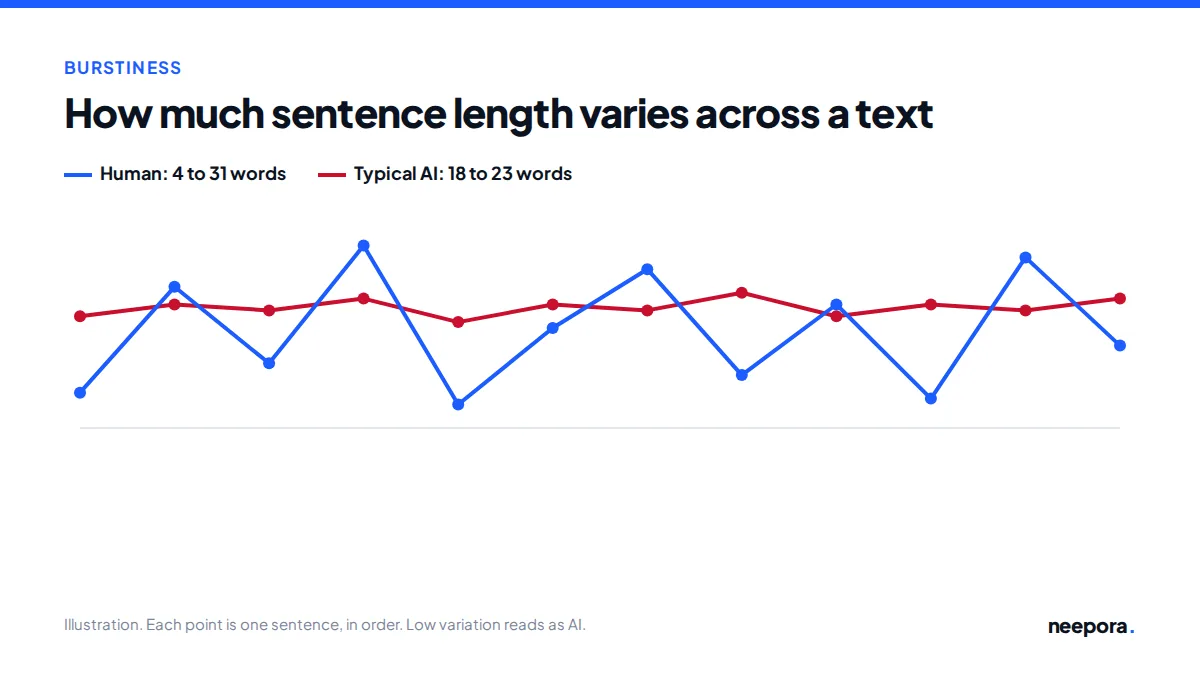
Burstiness measures that variation across a whole text. Low burstiness, where everything is evenly paced, is one of the clearest signals a detector uses.
Most current detectors go further than two measurements. They are models themselves, trained on large collections of human writing and AI writing until they can tell the two apart. This makes them better at the job and harder to explain. A classifier can say a sentence reads as AI without being able to say exactly why.
Whatever the method, the same features keep turning up in flagged text:
No single word gets a text flagged. The pattern across the whole text does.
An AI detector is not a plagiarism checker. It does not compare your text with any source, so a completely original text can still read as AI. It cannot see how the text was produced either: not your drafts, not your typing, not which tool you had open.
Because all of this is measurement and estimation, the output is a likelihood, not a finding. Two detectors can disagree about the same paragraph. Short texts give a detector very little to measure, which is why most tools ask for a minimum length and are least reliable near it.
A score is a reason to look more closely. It is not proof of who wrote something. We cover the evidence in are AI detectors accurate?
Some AI providers can build a statistical watermark into the text their own models generate, and then check for it later. That only works for text from that provider, and only if the watermark survives editing. It is a different technique from the detectors described here, which read the writing itself. The approach most often cited is the green-list watermark proposed by Kirchenbauer and colleagues in 2023.
If you are checking someone else's work, treat the result as evidence and read the flagged sentences yourself. If your own writing was flagged, the sentence-level view matters more than the headline number. The flagged lines usually share one habit, and that habit can be fixed.
The neepora AI detector shows its result sentence by sentence for that reason.
Mitchell et al., zero-shot detection using probability curvature (2023). Detects model text by how its likelihood changes under small rewrites.
Kirchenbauer et al., A Watermark for Large Language Models (2023).
Weber-Wulff et al., Testing of detection tools for AI-generated text (2023).
Why is my writing flagged as AI?
Updated October 7, 2026