
Seven things a careful reader can spot, the words that give AI text away, and the limits of judging by eye.
You can often tell that something was written by AI before you can say why. The reasons are specific, and once you have seen them they are hard to miss. Here is a paragraph of typical AI writing to work from:
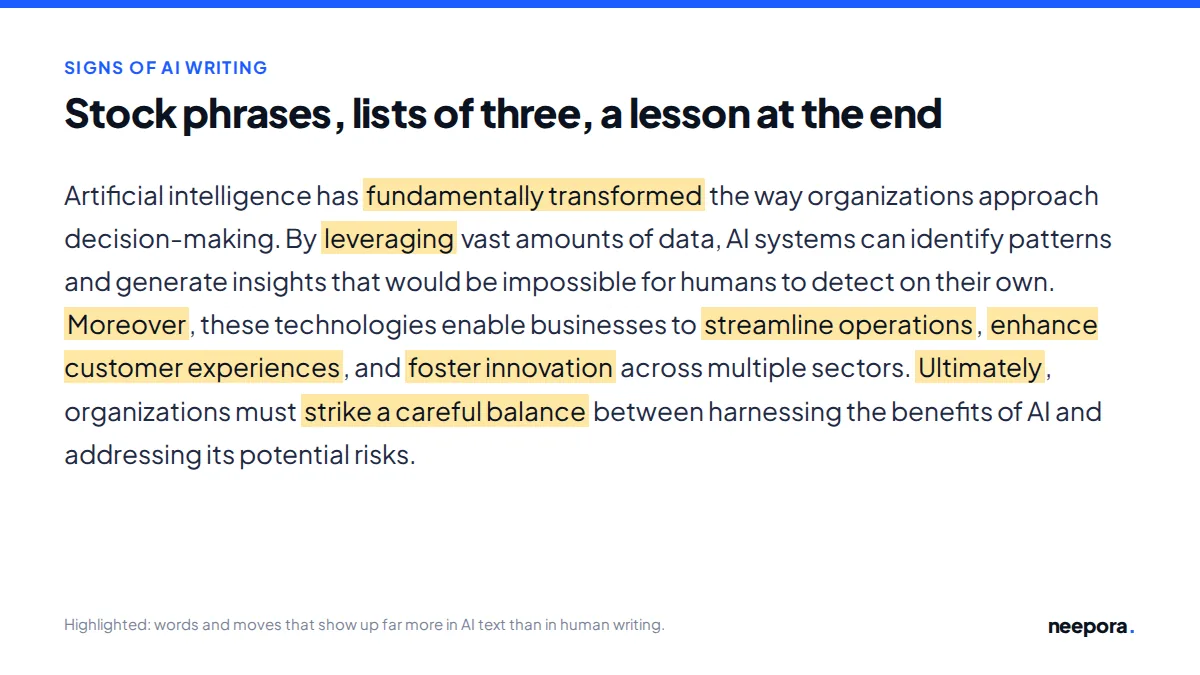
"Artificial intelligence has fundamentally transformed the way organizations approach decision-making. By leveraging vast amounts of data, AI systems can identify patterns and generate insights that would be impossible for humans to detect on their own. Moreover, these technologies enable businesses to streamline operations, enhance customer experiences, and foster innovation across multiple sectors. Ultimately, organizations must strike a careful balance between harnessing the benefits of AI and addressing its potential risks."
Count the words in each sentence above. None is short and none sprawls. They all land somewhere between a dozen and thirty words. People do not write like that for long. They get impatient, or they get carried away.
Moreover. Furthermore. Additionally. Ultimately. In conclusion. It is important to note that. AI text leans on these to move from one sentence to the next, usually at the very start of the sentence.
"Streamline operations, enhance customer experiences, and foster innovation." Three items, each a verb and an object, with a rhythm like a slogan. One of these is normal. One in every paragraph is a sign.
The first sentence announces the topic. The last one steps back and tells you what it all means, often with a word like "ultimately" or "balance". Human paragraphs sometimes just stop.
Which organizations? What data? What happened? The paragraph never says. AI writing is fluent about categories and thin on particulars: no names, no dates, no moment that only the writer would know.
Benefits on one side, risks on the other, and a call for careful balance at the end. AI text rarely commits to a view, and it rarely sounds annoyed, amused or unsure.
No typos, no asides, no change of register. The tone on the last line is the tone on the first.
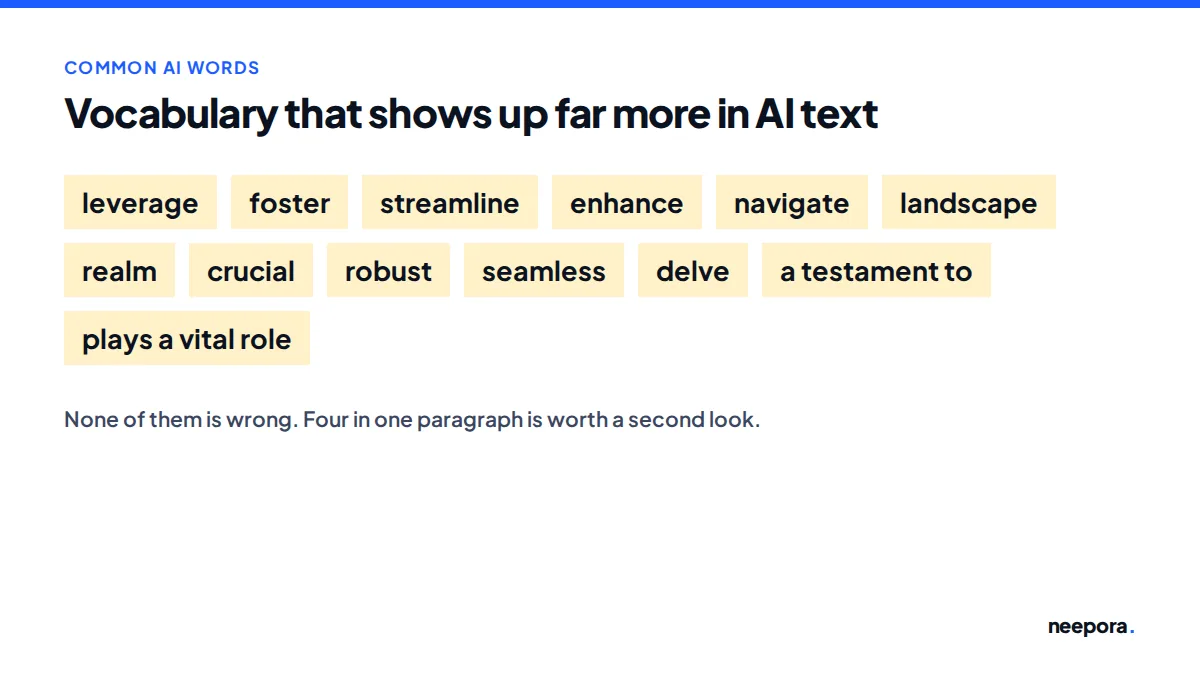
Some vocabulary shows up far more in AI text than in everyday writing: leverage, foster, streamline, enhance, navigate, landscape, realm, crucial, robust, seamless, delve, a testament to, plays a vital role. None of them is wrong. A paragraph with four of them is worth a second look.
People write this way too. Anyone trained on the five-paragraph essay, anyone writing formally, and many people writing in a second language will show several of these habits. And a careful human edit removes most of them from an AI draft.
So the signs are a reason to read more closely. They are not proof. Read are AI detectors accurate? before you rely on any single signal.
The neepora AI detector does this sentence by sentence and shades each one by how likely it is to be AI. It is free for up to 500 words without an account.
Kobak et al., excess vocabulary in 15 million biomedical abstracts (2024). Tracks the sudden rise of style words such as delves, showcasing and underscores after 2022.
Liang et al., GPT detectors are biased against non-native English writers (Patterns, 2023).
Why is my writing flagged as AI?
How to avoid AI detection in your writing
Check a text with the AI detector
Updated October 7, 2026