
Eight editing steps that lower AI detection scores, why they work, and the popular shortcuts that do not.
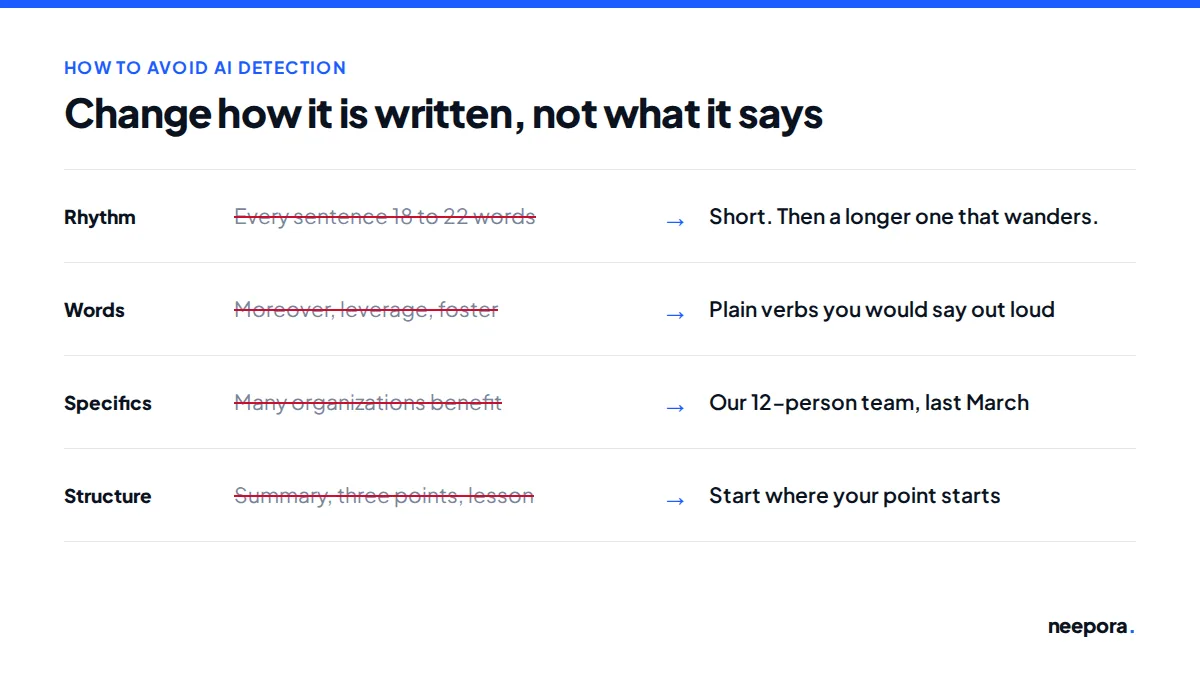
To avoid AI detection, make your writing less predictable. Vary sentence length, replace stock phrases and safe vocabulary with the words you would actually say, add specific details from your own experience, and rewrite whole sentences rather than swapping synonyms. Tricks like hidden characters or deliberate typos are unreliable and easy to spot.
Detectors look for writing that is statistically easy to predict. Language models choose likely words and produce sentences of similar length and shape, so their output scores low on surprise and low on variation. Human writing is lumpier: a short sentence after a long one, an unexpected word, a detail no one else would include. Avoiding detection means putting that lumpiness back. More detail is in how AI detectors work.
These shortcuts are widely shared online. Most of them either fail against current detectors or make the text worse in ways a human reader notices immediately.
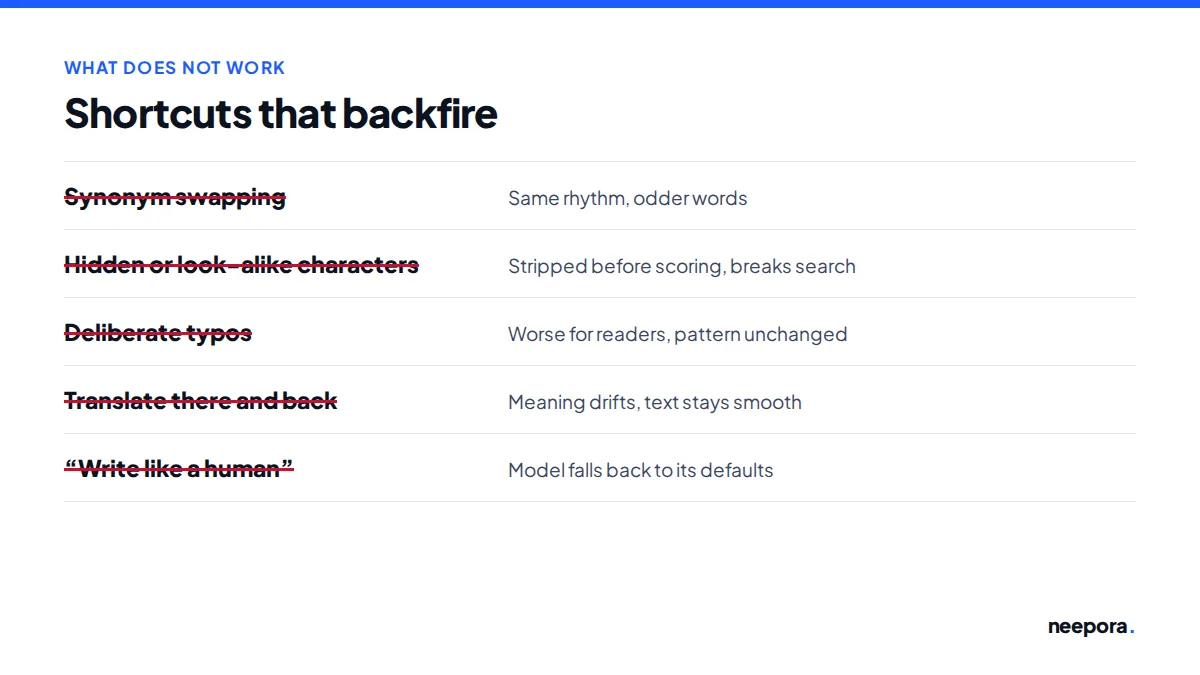
| Shortcut | Why it fails |
|---|---|
| Synonym swapping | The sentence structure and rhythm stay the same, and odd synonyms make the text harder to read. |
| Hidden characters or look-alike letters | Some tools strip them before scoring, and they break copy and paste, search and spell check. |
| Deliberate typos | They lower quality for every reader and do little to the overall pattern a detector measures. |
| Translating to another language and back | Meaning drifts and the result is often still smooth and predictable. |
| Asking a model to "write like a human" | The output usually follows the model's own defaults again: even sentences, the same stock phrases. |
Independent testing found that detector accuracy drops once text is paraphrased or edited by hand, which is why real editing is the approach that holds up.
An AI humanizer automates part of this work: it rewrites sentences with more varied structure and wording while trying to keep the meaning. It is a starting point, not a finished draft. Always read the result, check names, numbers and quotations, and edit anything that does not sound like you. neepora offers an AI humanizer that scores every result so you can see which sentences still read as predictable.
If your school, employer or publisher bans AI assistance or requires you to disclose it, follow that rule. No editing method changes what the rule asks of you, and getting around it is a breach of those rules and of most tools' terms of use, including ours. These steps are for writers whose own work is being flagged, and for drafts where AI help is allowed.
No method guarantees it. Detectors differ from each other and change over time. Heavily edited text written in your own voice scores lowest, but any score is a probability, not a certainty.
Paraphrasing lowers detection rates in independent tests, but simple synonym swapping does much less than rewriting sentence structure. Paraphrased text can still be flagged.
Varied sentence length, plain everyday words, specific details, a clear personal voice and fewer stock transitions such as Moreover and In conclusion.
Most detectors score the statistical pattern of the words, not hidden characters. Some tools remove invisible characters before scoring, so adding or removing them rarely changes the result.
Write from your own outline, vary your sentence length, cut filler phrases and add specific details. Keep your drafts and version history in case your work is questioned.
Often, yes. A sudden change in style, vocabulary or quality compared with your earlier work, or not being able to explain your own argument, is noticeable to a reader regardless of any detector score.
Weber-Wulff et al., Testing of Detection Tools for AI-Generated Text (2023).
Liang et al., GPT detectors are biased against non-native English writers (Patterns, 2023).
Why is my writing flagged as AI?
How to humanize AI text without losing meaning
Updated October 10, 2026